
Syntax
The DATEADD() function returns a date time (smalldatetime).
DATEDADD(interval, increment (int), expression (date))
This function is commonly used in date and time related queries.
Parameters
• interval: The date and time interval to add. It can be "year", "month" (or M), "day" etc. This is required.
• increment (in): An integer value (a number) of interval to add to the date. This is required.
• expression (date): A date value.
Example:
SELECT DATEADD(M, 3, GETDATE()) as Three_months_from_now -- Get the 3rd month from the current month.
Now, let's see how we can get the last 3 months records (in a Table) using DATEADD() function.
Create a Table
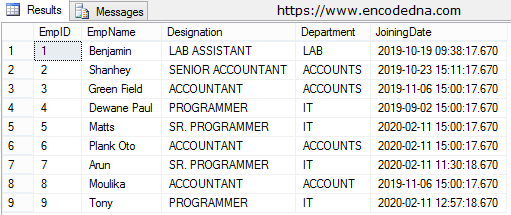
Let us assume, I have an employee table with few records in it. The table has a date column (the last column). See the image.
Note: Adjust or update the dates in the table (see the image below), to get proper result.
Query to get Last 3 Months Records
SELECT *FROM Employee
WHERE JoiningDate >= DATEADD(M, -3, GETDATE())
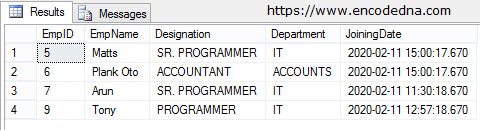
The Output
Related example: How to Retrieve Last 5 Minutes of Data in SQL Server: 3 Efficient Query Examples
Its a one line query. The function DATEADD() takes 3 parameters.
1) The first parameter is the M, which denotes a month. You can replace the M with the MONTH. Like this,
SELECT *FROM Employee
WHERE JoiningDate >= DATEADD(MONTH, -3, GETDATE())
2) The second parameter is "increment" (an integer value or a number). I am using -3 to get the last 3 months records or data. You can use -5, -4 or any number, depending upon your requirement.
Similar example: How to find the First and Last day (in words) of a given month using a single SQL query?
💡 Thought you should know: You can use a variable to specify a number, and use the variable inside the DATEADD() function. Like this,
DECLARE @D INT
SET @D = 3
SELECT DATEADD(M, @D, GETDATE())
3) The third parameter inside the DATEADD() function, is an expression or date. I am using the "GETDATE()" function for current month.
Note: The DATEADD() function is also supported by Azure SQL Database.